
Last updated:
HMA Wealth may earn a commission if you sign up through some links on this page. This does not affect our recommendations. See our Disclaimer for details.
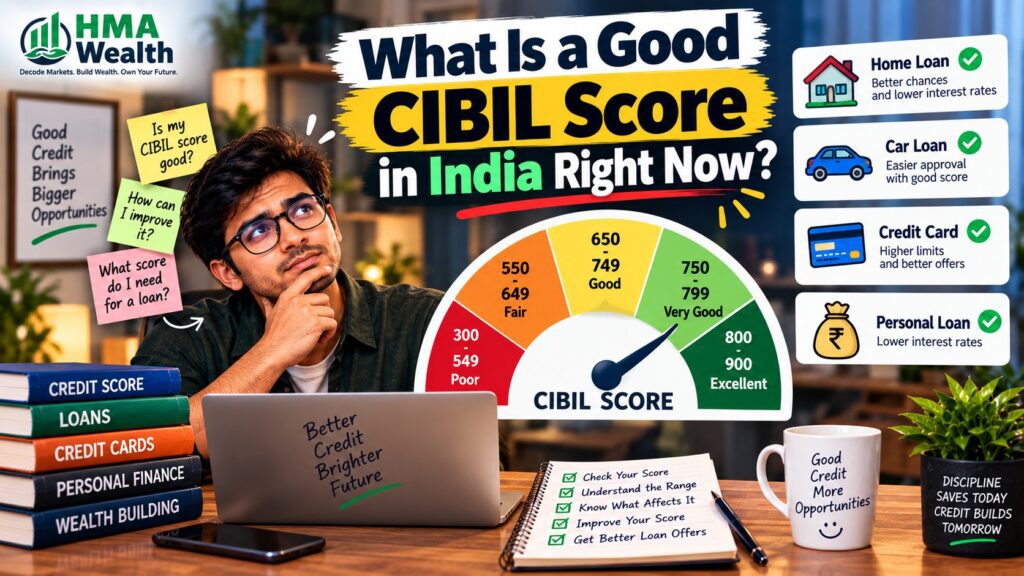
Table of Contents
Two years ago, a reader at HMA Wealth applied for the same personal loan amount at two different NBFCs within the same week. One offered him 11.5% interest. The other quoted 16%. Same income, same employer, same loan amount. The only real difference on paper was his CIBIL score: 742 at the first lender’s pull, which had dropped to 708 by the second pull after a credit card bill slipped past its due date. That five-point gap in perception, and the real 34-point drop, cost him close to ₹40,000 in extra interest over the loan tenure. If you’ve ever wondered what is a good CIBIL score and why lenders seem to treat it like a verdict rather than just a number, that gap is the whole answer.
What Is a CIBIL Score, and Why Does This One Number Carry So Much Weight?
CIBIL, short for the Credit Information Bureau (India) Limited, is India’s oldest and most widely used credit bureau. Your CIBIL score is a three-digit summary, built from your Accounts and Enquiries history, that tells a lender how reliably you’ve handled borrowed money in the past. Banks and NBFCs don’t see your bank balance or your salary slip at the moment they pull your score; they see a number on a 300-900 scale, and that number does a lot of the talking before a human ever reviews your file.
This is exactly why asking what is a good CIBIL score isn’t a trivia question. It’s the first filter most lenders apply, often before they look at your income documents, your employment history, or even the loan amount you’ve requested.
What Score Range Actually Counts as Good, Fair, or Poor?
CIBIL itself confirms the score runs from 300 to 900, with scores closer to 900 giving you a better shot at approval. Individual lenders set their own internal cutoffs on top of that scale, but these are the bands most Indian banks and NBFCs commonly work with:
| CIBIL Score Range | Category | What It Typically Means |
|---|---|---|
| 750-900 | Excellent | Fast approvals, access to the lowest advertised interest rates |
| 700-749 | Good | Generally approved, but not always at the lender’s best rate |
| 650-699 | Fair | Approval possible, often with a higher interest rate or a co-applicant requirement |
| 550-649 | Poor | Frequent rejections, or approval only through secured/collateral-backed products |
| 300-549 | Very Poor | Approval unlikely without a guarantor or a significant improvement in repayment history |
| No score (“NA” or “NH”) | No credit history | Treated cautiously, since there’s no repayment pattern to evaluate |
So when someone asks what is a good CIBIL score in practical terms, 750 and above is the number most lenders treat as genuinely good, the point where you stop being “approvable” and start being someone lenders actively compete for.
Why Do Lenders Treat 750 as the Real Benchmark?
It isn’t an arbitrary round number. A score of 750+ typically signals a long enough credit history with on-time payments, healthy credit utilisation (how much of your available credit limit you’re actually using), and a reasonable mix of secured and unsecured credit, without too many recent loan enquiries crowding your report. Lenders read all of that as low risk, and low risk is what earns you their best-priced products.
That’s also why the honest answer to what is a good CIBIL score changes slightly depending on what you’re applying for. A credit card issuer might comfortably approve applicants at 700, while a bank sanctioning a large home loan may want to see 750 or higher before offering its most competitive rate.
How Much Can Your Score Actually Move Your Loan’s Interest Rate?
This is where the number stops being abstract. Lenders price risk into interest rates, and a stronger score often means a meaningfully lower one. Using the earlier example of a ₹5 lakh personal loan over three years, here’s an illustrative comparison of how the same loan can price out differently depending purely on score band (figures are indicative only, not a quote from any specific lender):
| Score Band | Illustrative Interest Rate | Illustrative Total Interest Paid (3 years) |
|---|---|---|
| 750-900 | ~11-12% | ~₹90,000 |
| 700-749 | ~13-15% | ~₹1,10,000 |
| 650-699 | ~16-18% | ~₹1,35,000 |
These numbers will vary by lender, loan type, and your overall profile, so treat the table as a demonstration of direction, not a promise of what you’ll be quoted. Still, it’s a useful way to see why chasing a few extra points before a big loan application is rarely wasted effort.
What Happens If You Have No CIBIL Score at All?
A surprising number of first-time earners assume “no score” is safer than “low score.” It isn’t automatically either. CIBIL calls this a “No Hit,” meaning there isn’t yet enough credit activity on your file to generate a score. Lenders tend to treat it cautiously, since they have nothing to evaluate your repayment behaviour against, which can mean smaller initial credit limits, secured credit card offers, or a request for a guarantor until you build a track record.
If this is you, a secured credit card against a fixed deposit, or becoming an authorised add-on user on a family member’s well-managed card, are common, low-risk ways to start generating a credit history. Our guide on how to check your credit score walks through the free platforms where you can track that history as it starts to build.
Most first-time earners in their early twenties fall into this No Hit category, and that’s completely normal rather than a red flag. Lenders expect a thin file at that stage of life, which is exactly why starter products like secured cards and small-ticket consumer loans exist: they’re designed to help you build a track record safely, without the higher stakes of a large unsecured loan while your credit file is still forming.
Does Every Lender See the Same CIBIL Score You Do?
Not exactly, and this is a detail that trips people up when two lenders quote different numbers in the same week, much like what happened in the example at the start of this article. The raw score CIBIL generates is based on your credit history as it stood on the date of that specific pull, so a payment that posts between two applications, or a fresh hard enquiry from another lender, can shift the number within days. On top of that, many banks and NBFCs layer their own internal risk model on top of the CIBIL score itself, weighing factors like your salary band, employer category, and existing relationship with that bank, before arriving at a final approval decision and rate.
That’s also part of why there’s rarely one clean answer to what is a good CIBIL score across every lender and every product. A score that comfortably clears one bank’s internal threshold for a credit card might fall just short of another bank’s cutoff for a large home loan, even though both are pulling from the same underlying CIBIL report.
What Pulls a Good Score Down Faster Than People Expect?
- Missed or late payments, even by a few days, which is the single biggest factor in most scoring models
- High credit utilisation, generally keeping it under 30% of your total available limit across all cards
- Too many loan or credit card enquiries in a short window, which can read as credit-hungry behaviour to a lender’s model
- Closing your oldest credit card, which shortens your average account age and can pull your score down unexpectedly
- Errors in your credit report, like a loan that isn’t yours or a payment wrongly marked late, which happen more often than most people realise
If you spot something that doesn’t look right on your report, it’s worth reading our walkthrough on how to fix errors in your credit report before you assume the drop is something you did.
How Do You Realistically Build Toward a Good Score If You’re Not There Yet?
There’s no shortcut that works faster than consistent behaviour over time, and anyone who promises an overnight fix is usually selling something. What actually moves the number:
- Pay every EMI and credit card bill on or before the due date, every single month, without exception.
- Keep credit utilisation low, ideally under 30%, even if that means paying your card down mid-cycle rather than waiting for the statement date.
- Avoid applying for multiple loans or cards in quick succession, since each hard enquiry can shave a few points off your score.
- Maintain a healthy mix of credit, such as a long-standing credit card alongside an EMI-based loan, rather than relying on just one type.
- Check your report periodically for errors, since an unresolved mistake can sit there and drag your score down for months.
This is also where your choice of credit card, and how you use it, quietly compounds over time. If you’re comparing options, our breakdown of the best personal loans in India covers how lenders weigh your score alongside income and existing obligations when deciding what to offer you.
Who Regulates CIBIL, and Can You Trust the Number It Gives You?
CIBIL operates in India as a Credit Information Company licensed and regulated under the Credit Information Companies (Regulation) Act, with oversight from the Reserve Bank of India. That regulatory structure is part of why lenders lean on the score so heavily; it isn’t a private app’s proprietary guess, it’s a regulated bureau pulling from data that banks and NBFCs are themselves required to report. You’re also legally entitled to one free full credit report from CIBIL every year, which is worth pulling even if you already monitor your score through a banking app, since the full report shows the account-level detail that the headline number alone doesn’t.
Does a Good Score Guarantee Loan Approval?
No, and this is worth saying plainly. A 780 CIBIL score significantly improves your odds and your pricing, but it doesn’t override a mismatched income-to-loan ratio, an unstable employment history, or a lender’s internal policy on a specific product. CIBIL itself is clear that the final lending decision always rests with the bank or NBFC, not with the score alone. Think of a good score as the door that gets you a seat at the table, not a guarantee of the outcome once you’re there.
Does the Bar Change for Self-Employed Borrowers and Business Owners?
A little, yes. Self-employed applicants and business owners are often judged on a slightly stricter version of the same scale, simply because their income documentation (profit and loss statements, ITRs, GST filings) carries more variability than a fixed salary slip does. A 750+ score still opens the same doors it does for a salaried applicant, but lenders frequently pair it with a closer look at income stability over the past two to three years, bank statement patterns, and existing business loans before finalising a rate.
If you run a business or freelance and your income fluctuates seasonally, it’s worth being proactive rather than reactive about your score: keep utilisation low even in lean months, avoid letting a slow quarter turn into a missed EMI, and don’t stack multiple business and personal loan applications in the same window, since lenders read that pattern as strained cash flow rather than ambition.
HMA Wealth exists to turn exactly this kind of confusing, lender-specific fine print into something you can actually act on, grounded in how Indian banks and NBFCs genuinely underwrite credit, not just textbook theory.
This article is educational content meant to help you understand what is a good CIBIL score and how that number is actually used, not personalised financial or lending advice. Your own approval odds, interest rate, and credit-building timeline depend on your individual financial situation, so for decisions specific to your circumstances, it’s worth consulting a SEBI-registered investment adviser or speaking directly with your lender. CIBIL scores, lending norms, and interest rate bands shift over time, so always verify current figures against the official CIBIL website before making a borrowing decision.
At the end of the day, the real answer to what is a good CIBIL score isn’t a single magic number; it’s whatever score gets you the interest rate and approval odds you’re actually chasing for your next loan, and 750 is simply the point where most Indian lenders stop asking questions and start competing for your business. Track it, protect it, and treat every on-time payment as the small deposit it actually is toward that number.
FAQs — What Is Considered a Good CIBIL Score in India Right Now?
What is a good CIBIL score in India?
Most Indian lenders treat 750 and above, out of the 300-900 scale, as the real answer to what is a good CIBIL score. At this level you typically get faster approvals and the lowest advertised interest rates, while 700-749 is still workable but not always at a lender’s best pricing.
Is 700 considered a good CIBIL score?
A 700 score sits in the “good” band on most lender scales, so the short answer to what is a good CIBIL score at 700 is yes, generally approvable. It may not unlock the absolute lowest interest rate a bank offers, which usually goes to applicants scoring 750 or higher.
What is a good CIBIL score for a home loan?
For a home loan, lenders typically want to see 750+ before offering their most competitive rate. Anything from 700-749 can still get approved, but what is a good CIBIL score for home loans really depends on the bank’s internal cutoff and your income-to-loan ratio.
Can I get a loan with no CIBIL score at all?
Yes, though it’s harder. A “No Hit” means there isn’t enough credit history to generate a score yet, so while the usual benchmark for what is a good CIBIL score doesn’t apply, lenders often offer secured cards or small loans to help you build a track record first.
How often does my CIBIL score change?
Your score can shift within days, since it reflects your credit activity as of each specific pull, including new payments or fresh loan enquiries. That’s why two lenders checking what is a good CIBIL score for the same applicant in one week can sometimes see slightly different numbers.