
Last updated:
HMA Wealth may earn a commission if you sign up through some links on this page. This does not affect our recommendations. See our Disclaimer for details.
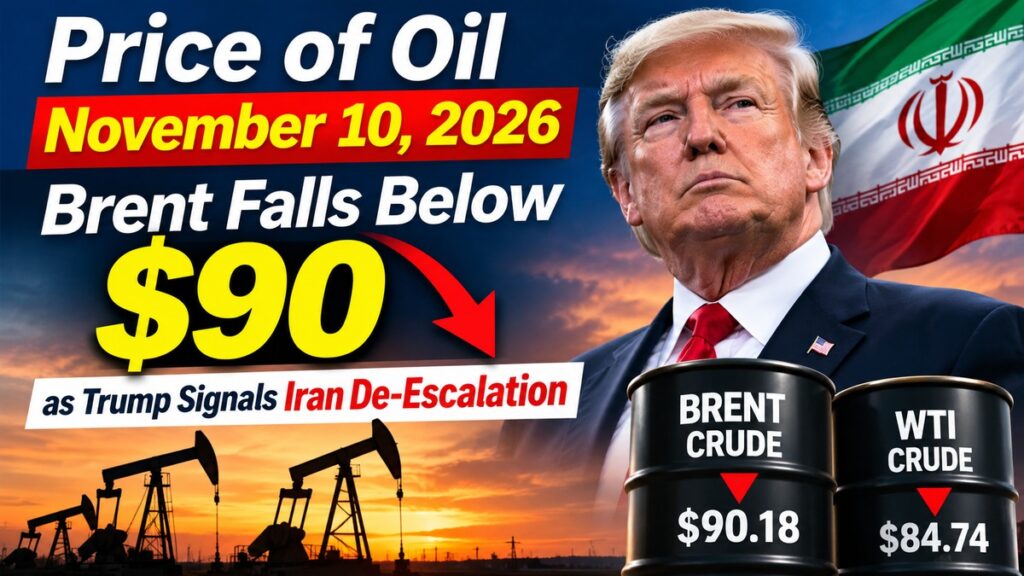
Table of Contents
Oil prices are falling again, and the latest move is giving investors a fresh reason to reconsider the outlook for inflation, energy stocks and the broader US economy. On November 10, 2026, Brent crude briefly dropped below $90 per barrel for the first time since August 31, following comments from President Donald Trump suggesting that additional military action against Iran may not be necessary. US West Texas Intermediate (WTI) crude also declined, extending the previous session’s sharp sell-off.
What Happened to Oil Prices on November 10, 2026?
The latest movement in the price of oil November 10 2026 reflects changing expectations about geopolitical risks and global energy supplies.
According to Reuters, Brent crude futures were down $2.39, or 2.58%, at $90.18 per barrel by 0930 GMT on Tuesday. US WTI futures declined $2.11, or 2.43%, to $84.74 per barrel.
Brent briefly moved below the $90 threshold during the session, marking its first move beneath that level since August 31. The benchmark had already suffered a 5.85% decline in the previous trading session.
The immediate catalyst was Trump’s decision to signal that further military strikes against Iran could be put on hold. His comments followed appeals from regional countries, including Qatar’s prime minister.
Investors interpreted the softer tone as a sign that the possibility of prolonged disruption to Middle Eastern oil supplies could be easing.
However, this does not mean geopolitical risks have disappeared. Shipping attacks around the Strait of Hormuz are continuing, and the possibility of renewed tensions remains a concern.
Reuters reported that Brent had fallen approximately 23% from its six-month high of $118 per barrel reached on October 30.
Source: Reuters – Oil Falls Below $90 as Trump Downplays Prospect of Escalation With Iran.
Why Is the Price of Oil November 10 2026 Falling?
There are two major reasons behind the latest decline: easing geopolitical concerns and growing expectations of excess global oil supply.
1. Trump Signals Reduced Military Escalation Against Iran
The Middle East remains one of the world’s most important regions for energy transportation and production.
Any serious disruption involving Iran or the Strait of Hormuz can create concerns about the availability and transportation of crude oil. When traders fear supply interruptions, they often build a geopolitical risk premium into oil prices.
That premium can push crude higher even before an actual shortage develops.
However, Trump’s latest comments have changed market expectations. By suggesting that additional military action against Iran is not currently necessary, he has reduced some of the immediate concerns surrounding a prolonged conflict.
According to the Wall Street Journal’s November 10 market coverage, investors were also watching the possibility of further de-escalation as Brent traded near its lowest levels since late August.
Source: The Wall Street Journal – Stock Market Today: Oil Prices Fall to $90 a Barrel.
2. Global Oil Supply Is Showing Signs of a Surplus
Geopolitics is only one part of the story.
Reuters reported that JPMorgan estimated the global oil market surplus at approximately 1.4 million barrels per day in October.
This matters because oil prices depend on the balance between supply and demand.
When producers supply more crude than consumers need, inventories can increase and prices may come under pressure.
Reuters also reported that OPEC oil production increased in October, led by Saudi Arabia, Kuwait and Iraq, according to its survey.
At the same time, elevated oil prices have been weighing on demand.
This combination of increasing production and softer consumption is creating another headwind for crude.
The price of oil November 10 2026 is therefore responding to more than political headlines. The underlying supply-demand balance is becoming an increasingly important part of the market outlook.
What Does Falling Oil Mean for US Investors and Consumers?
For regular Americans, cheaper crude oil can have consequences extending far beyond energy trading.
The first area to watch is gasoline.
Crude oil is a major input in gasoline production, so sustained declines in crude prices can eventually reduce wholesale fuel costs. However, retail gasoline prices do not move immediately or perfectly alongside crude.
Refining margins, distribution expenses, taxes and regional supply conditions also influence what drivers pay at the pump.
The second area is inflation.
Energy costs influence transportation, manufacturing, logistics and several other parts of the economy. If lower crude prices persist, they could help reduce some inflationary pressure.
That could matter for the Federal Reserve as it evaluates inflation trends and future interest-rate decisions.
The Wall Street Journal highlighted the October US Consumer Price Index release as an important event for investors on November 10.
For stock market investors, the impact is more complicated.
Airlines and transportation businesses could benefit from lower fuel expenses, assuming other operating conditions remain supportive. On the other hand, oil producers and energy companies may face pressure on revenue and profitability if crude prices remain weak.
Investors should also distinguish between short-term market reactions and longer-term business performance.
A falling oil price does not automatically make every airline stock attractive, just as higher crude prices do not guarantee stronger energy-sector returns.
For more practical investment insights, explore HMA Wealth’s Investing and Trading and Financial Education resources.
You can also explore Stockcharcha’s financial rules to understand the principles behind financial planning and investment decisions.
The biggest lesson is to look beyond the headline price. Investors need to understand why oil is moving and which businesses are most exposed to that movement.
What’s Next for Oil Prices?
The next direction for crude will depend on whether diplomatic progress between the United States and Iran becomes more durable.
Traders will also monitor developments around the Strait of Hormuz, OPEC production, global demand and the latest US economic indicators.
The US Energy Information Administration’s November Short-Term Energy Outlook is another important event to watch for updated supply, demand and price forecasts.
For investors, the key question is whether the recent decline represents a temporary unwinding of geopolitical risk or the beginning of a longer period of weaker crude prices.
The price of oil November 10 2026 shows how quickly energy markets can react when political expectations change. But until supply conditions and geopolitical risks become clearer, volatility remains part of the picture.
Disclaimer: This article is for informational and educational purposes only and does not constitute investment advice. HMA Wealth is not an SEC-registered investment adviser. Commodity and energy-related investments involve market risks, and readers should conduct independent research before making financial decisions.
FAQs – Price of Oil November 10 2026
What is the price of oil on November 10, 2026?
Brent crude futures were trading at $90.18 per barrel, down 2.58%, while US WTI crude declined to $84.74 per barrel, down 2.43%, by 0930 GMT, according to Reuters. Brent briefly fell below $90 during the session.
Why are oil prices falling today?
Oil prices are declining because President Donald Trump signalled that additional military action against Iran may not be necessary. This eased some concerns about prolonged supply disruptions in the Middle East. Expectations of excess global oil supply are also putting pressure on crude prices.
What is the difference between Brent and WTI crude oil?
Brent crude is an international oil benchmark used to price a large portion of globally traded petroleum. West Texas Intermediate (WTI) is the primary US crude benchmark. Their prices can differ because of crude quality, transportation costs, supply conditions and regional market dynamics.
Will falling oil prices reduce US gasoline prices?
Lower crude prices can eventually reduce gasoline production costs and wholesale fuel prices. However, retail gasoline prices also depend on refining margins, taxes, transportation expenses and regional supply. Therefore, consumers may not experience immediate reductions at gas stations.
How do falling oil prices affect the US stock market?
Lower crude prices can benefit airlines, transportation companies and other fuel-intensive businesses by reducing operating expenses. However, oil producers and energy companies may face lower revenue if prices remain weak. The overall stock market impact depends on inflation, economic growth and individual company performance.