Table of Contents
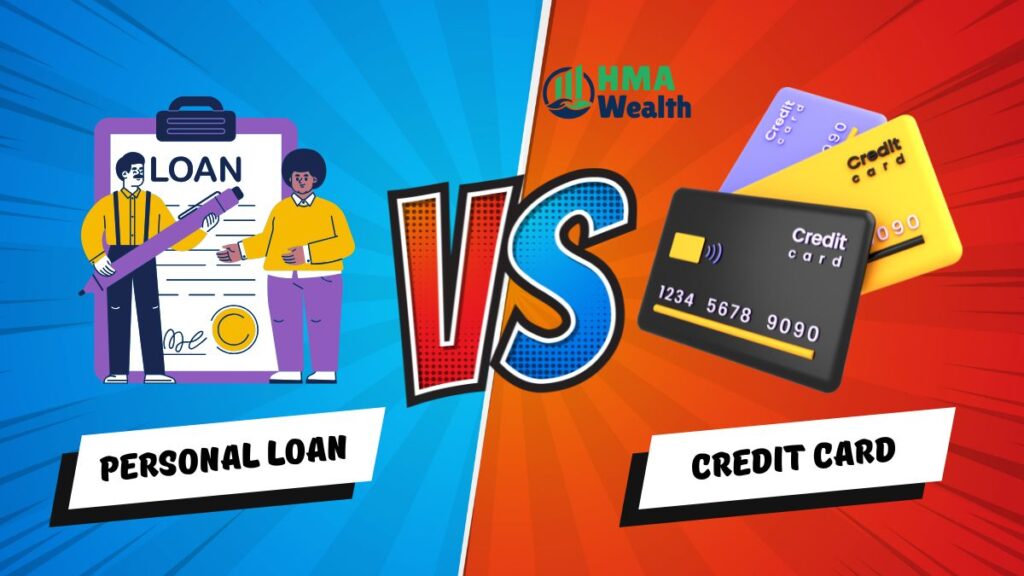
Should you put a big, unexpected expense on a credit card, or take a personal loan instead? Most comparison articles answer that with a generic rule (“loans are cheaper for large amounts, cards for small ones”) that falls apart the moment you look at the actual numbers on your specific card and your specific loan offer.
A friend of mine ran into this exact problem over a ₹40,000 dental procedure her insurance wouldn’t cover. She had a credit card with enough limit sitting unused, and she also qualified for a quick personal loan through her salary account. Same amount, same urgency, two completely different tools, and she genuinely didn’t know which one would actually cost her less by the time she was done paying it off.
That’s the real question underneath “personal loan vs credit card.” It isn’t about which product is universally better. It’s about matching the right tool to the specific shape of your expense, and getting that wrong can quietly cost you tens of thousands of rupees you never needed to spend.
What’s the Actual Structural Difference Between the Two?
Start here, because everything else in this article builds on it.
A personal loan is what’s called installment credit. The bank hands you a fixed lump sum upfront say ₹3 lakh and you repay it in equal monthly installments (EMIs) over a set tenure, usually anywhere from one to five years. Once it’s disbursed, that’s it. You can’t borrow more against the same loan; if you need more money later, you apply again.
A credit card is revolving credit. There’s no lump sum handed over instead, you get a credit limit you can dip into repeatedly, pay down, and dip into again, indefinitely, as long as you stay within that limit and keep making at least the minimum payment. This flexibility is genuinely useful for day-to-day spending, but it’s also exactly what makes credit card debt so easy to underestimate.
| Personal Loan | Credit Card | |
| How you receive funds | One lump sum, upfront | Ongoing credit limit, reusable |
| Repayment structure | Fixed EMI over a set tenure | Minimum due, or full statement |
| Interest type | Usually fixed for the loan term | Variable, charged only if unpaid |
| Best suited for | One large, defined expense | Smaller, short-term spends you can clear fast |
How Do the Interest Rates Actually Compare?
This is where the gap surprised me the first time I actually sat down and worked out real numbers instead of just going by the headline percentages banks advertise.
Personal loan interest rates in India, as of mid-2026, generally run somewhere between 10% and 16% per annum for borrowers with a healthy credit score and stable income RBI’s repo rate has held steady since January 2026, which is part of why most bank rates have settled into this band. Borrowers with a weaker credit profile can see NBFC rates climb to 24%–36%, so the rate you’re quoted depends heavily on your own credit history, not just which lender you pick. As always, treat these as indicative banks revise rates fairly often, so check the current numbers on your shortlisted lender’s own page before applying.
Credit cards work very differently, and this is the part that catches people off guard. If you don’t clear your full statement balance by the due date, most Indian credit cards charge finance charges of roughly 2.5% to 4% per month which works out to an effective 30% to 48% annualised. That’s not a typo, and it’s not a worst-case scenario reserved for “bad” cards; it’s the standard rate structure on the vast majority of cards issued by major Indian banks.
Here’s the mechanic that genuinely surprised me: if your bill is ₹1,00,000 and you pay ₹95,000 just ₹5,000 short most issuers charge interest on the entire ₹1,00,000 for that billing cycle, not just the shortfall. That single detail is why “I paid most of it” on a credit card can still cost you real money. One thing that has genuinely improved for cardholders: RBI’s rules on late payment fees, which apply to all Indian card issuers and cap how much a late fee can run based on your outstanding amount, rather than letting issuers charge a flat penalty regardless of the balance.
When Does a Personal Loan Actually Make More Sense?
A personal loan tends to win once you’re looking at:
- A large, one-time expense a wedding cost, a medical bill, a home renovation where you know the total amount upfront and want predictable EMIs rather than an open-ended balance.
- A borrowing amount above roughly ₹50,000-₹1 lakh, where the interest rate gap between a loan and revolving credit card debt starts adding up to real money over a few months.
- Debt consolidation, where you’re using the loan specifically to pay off high-interest credit card balances and replace them with one lower, fixed EMI.
- A repayment timeline you want locked in from day one, so you know exactly when the debt ends, rather than an open-ended balance you could theoretically carry for years.
For anyone weighing this specifically, HMA Wealth’s guide on best personal loans in India breaks down how rates actually compare across banks and NBFCs worth a look before you apply anywhere, since the rate you’re quoted can vary meaningfully lender to lender for the same credit profile.
When Does a Credit Card Actually Make More Sense?
The flip side is just as real, and it’s not just “never use a credit card for borrowing” that’s an oversimplification.
- Short-term spends you’re confident you can clear within the interest-free period, typically 18 to 50 days depending on the card and your statement cycle. Used this way, a credit card effectively gives you a genuinely free, short-term loan.
- Smaller, everyday expenses where taking out a formal personal loan would be disproportionate to the amount nobody needs a bank loan for a ₹3,000 purchase.
- 0% EMI offers on specific purchases, provided you check for hidden processing fees first a genuine 0% EMI with no processing fee is rare but real, and worth using when it’s actually available.
- Building a track record of on-time payments, which, used responsibly, is one of the more effective ways to strengthen your credit profile over time.
How Does Each One Actually Affect Your CIBIL Score?
This is the part most comparison articles skip entirely, and it’s genuinely important if the title of this piece credit score is what brought you here.
Your CIBIL score is built heavily around two things: payment history and credit utilization. You can check your own score and the factors behind it directly at cibil.com. Credit utilization is the ratio of how much revolving credit (mainly credit cards) you’re using against your total available limit and this is a critical distinction an installment loan like a personal loan does not count toward that utilization ratio the same way a credit card balance does.
Practically, that means: if you’re carrying a high balance on your credit card and it’s pushing your utilization above roughly 30% of your total limit, taking a personal loan to pay off that card and replacing it with a fixed EMI can genuinely improve your score not because loans are inherently better, but because it lowers your revolving utilization while adding a positive repayment history on a different type of credit.
That said, neither product helps you if you mismanage it. A missed credit card payment or a bounced EMI does real, lasting damage a single missed payment can knock 50 to 100 points off a score depending on how late it runs, and that impact stays on your credit report for years. The mechanism differs, but the consequence of missing a payment doesn’t discriminate between loan types. If credit scores and how they actually work is new territory for you, HMA Wealth’s credit score section covers the broader mechanics beyond just this comparison.
How Do You Actually Apply for Each One, Step by Step?
Once you’ve decided which product fits your situation, the practical process differs a bit between the two.
For a personal loan:
- Check your CIBIL score first, since it directly determines both your eligibility and the rate you’re offered a score above roughly 750 typically unlocks the better end of the rate range.
- Compare at least three lenders your existing bank, one other private bank, and one NBFC since the same profile can be quoted meaningfully different rates depending on the lender’s current risk appetite.
- Submit income proof and KYC documents typically salary slips or bank statements, PAN, and Aadhaar most banks now process this entirely online for pre-approved or salaried customers.
- Review the sanction letter carefully before accepting check the exact rate, tenure, processing fee, and whether there’s a prepayment penalty, since these details don’t always match the advertised headline rate.
- Set up auto-debit for your EMI from day one, so a missed payment never comes down to forgetting a manual transfer.
For using a credit card to fund a large expense:
- Check your current available limit and utilization, not just your total credit limit using most of it for one purchase spikes your utilization ratio immediately.
- Confirm your exact statement and due dates, since the interest-free period only protects you if you pay in full by that specific date, not just “sometime this month.”
- Ask about a no-cost EMI conversion on the specific purchase if the amount is large many banks let you convert a big transaction into fixed installments, sometimes with genuinely zero interest if there’s no processing fee attached.
- Set a calendar reminder a few days before the due date, not on the day itself, so a payment delay or bank holiday doesn’t accidentally push you into finance charges.
- Track the balance weekly until it’s cleared, since revolving credit makes it easy to lose track of exactly how much you still owe against how much you’ve already paid.
What Mistake Did I See Someone Actually Make With This Decision?
The friend from the dental procedure at the start of this article ended up choosing the credit card not because it was cheaper, but because the application felt easier and she already had the limit sitting there unused. She assumed she’d pay it off within two months.
Three months later, she’d only cleared about 60% of it, because two unrelated expenses came up in between and she kept paying the minimum due instead. By the time she’d fully cleared the balance, she’d paid close to ₹6,000 in accumulated finance charges on a ₹40,000 expense money that a personal loan at a fixed 12% rate, cleared over the same period, would have cost her roughly a third of.
The lesson isn’t “credit cards are bad.” It’s that a credit card only stays cheap if you’re realistic about how fast you’ll actually clear the balance and “I’ll pay it off quickly” is exactly the kind of assumption life has a habit of interrupting.
What Should You Actually Check Before Choosing Either One?
A few concrete things worth doing before you commit to either route:
- Calculate the real cost, not just the headline rate. Use an EMI calculator for the loan option and compare it honestly against what the credit card would cost if you genuinely clear it in your expected timeline and then again if it takes twice as long, since that’s a realistic scenario worth planning for.
- Check your current CIBIL score first. Both your loan interest rate and your credit card’s actual terms depend heavily on where your score currently sits, so it’s worth checking before you assume either option is available to you at the advertised rate.
- Read the processing fee and prepayment terms. Personal loans often carry a processing fee of 1%–3%, and some charge prepayment penalties if you want to close the loan early details that change the true cost of borrowing.
- Be honest about your actual repayment timeline, not the optimistic one. If there’s real uncertainty about clearing a balance within a couple of months, the fixed EMI structure of a loan removes that uncertainty entirely.
If budgeting for either option feels like the harder part of this decision, HMA Wealth’s piece on the 50/30/20 rule for Indians is a useful starting point for figuring out how much room you actually have for a new EMI or credit card payment without straining the rest of your month.
Is There a Simple Way to Decide Between the Two?
If there’s one rule of thumb worth taking away from all of this: match the tool to the timeline, not the ease of access.
A large, defined expense you can’t clear within a couple of months genuinely belongs on a personal loan, where the fixed EMI and lower rate protect you from your own optimism about repayment speed. A smaller, short-term expense you’re confident about clearing fast is exactly what a credit card’s interest-free period exists for. The mistake isn’t picking the “wrong” product it’s picking based on which application felt more convenient in the moment, rather than being honest about how the expense actually behaves.
This is really the core of good borrowing content not telling you personal loans are good or credit cards are bad, but helping you see the actual mechanics clearly enough to make that call yourself, for your own specific number and your own specific timeline.
This article is educational content based on personal experience and publicly available rate information it isn’t personalised financial advice, and HMA Wealth isn’t a SEBI-registered investment adviser. Interest rates, fees, and terms mentioned here change fairly often, so verify current rates directly with your bank or NBFC before applying, and for borrowing decisions specific to your own financial situation, it’s worth speaking with a certified financial planner.
FAQs – Personal Loan vs Credit Card
Is a personal loan always cheaper than a credit card?
Usually, yes. In the personal loan vs credit card comparison, personal loans typically carry 10%–16% annual interest for good credit profiles, while unpaid credit card balances run 30%–48% annually. Credit cards only stay cheaper if you clear the full statement within the interest-free period.
Does taking a personal loan hurt my CIBIL score?
A new personal loan application causes a small, temporary dip from the hard inquiry. But in the personal loan vs credit card equation, consistent on-time EMI payments usually help your score over time by improving your credit mix and lowering revolving utilization.
Can I use a personal loan to pay off credit card debt?
Yes, this is one of the most common uses in the personal loan vs credit card decision. Consolidating high-interest credit card debt into one fixed, lower-rate EMI can reduce your total interest cost and lower your credit utilization ratio simultaneously.
Which one is better for a small, short-term expense?
For smaller amounts you can repay quickly, a credit card usually wins the personal loan vs credit card question. Used within the interest-free period, typically 18 to 50 days, it functions as a genuinely free short-term loan, without any loan paperwork.
Does a credit card or personal loan affect my credit utilization more?
Credit cards affect utilization directly, since it’s calculated against your revolving limit. This is a key distinction in personal loan vs credit card planning personal loans are installment credit and don’t count toward that same utilization ratio, even though both are unsecured debt.