
Last updated:
HMA Wealth may earn a commission if you sign up through some links on this page. This does not affect our recommendations. See our Disclaimer for details.
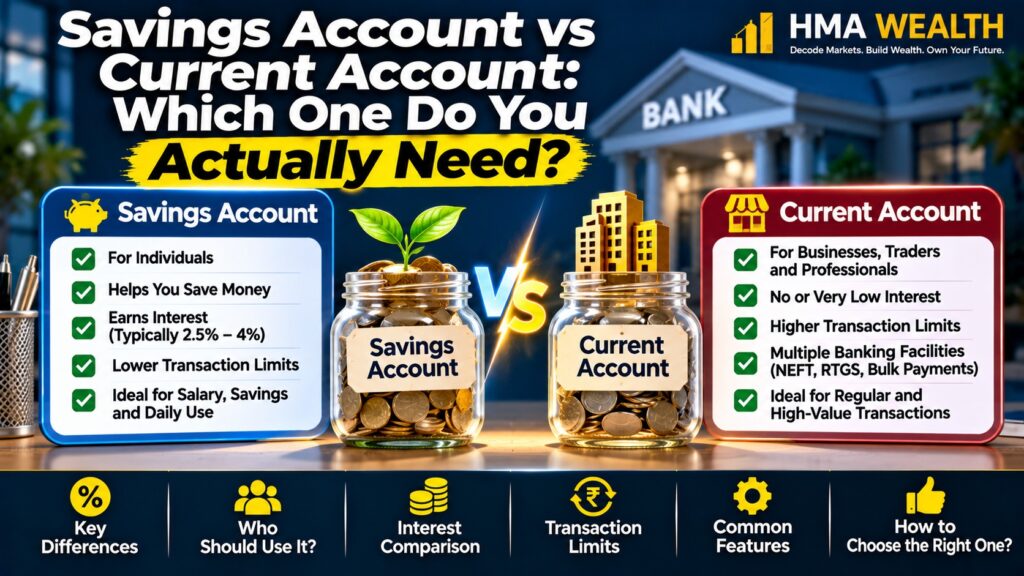
Table of Contents
A friend of mine who sells handmade candles on Instagram got a call from her bank one Tuesday asking her to walk into the branch “for a quick KYC update.” It wasn’t quick. Her savings account had been flagged for unusually high transaction volume, nearly 40 credits a month from different UPI handles, and the bank wanted to know why a personal savings account was behaving like a business account. She hadn’t done anything wrong, she just didn’t know the difference mattered.
That’s the exact confusion this savings account vs current account comparison is meant to clear up, because most people never actually choose between the two, they just open whatever account their bank pushes at account-opening time and figure out the difference only when something goes sideways. Getting the savings account vs current account choice right early saves exactly this kind of unpleasant surprise later. HMA Wealth gets this question constantly from readers juggling a side hustle alongside a salaried job, so here’s the honest, practical version, not the textbook one. If you’re just starting to build your financial foundation, our guide on how to start investing is worth reading alongside this one.
What’s the Actual Difference Between a Savings and a Current Account?
Let’s break the savings account vs current account question down from first principles. A savings account is built for individuals to park money and earn a small amount of interest on it, with transaction volumes expected to stay modest, salary credits, bill payments, occasional transfers. Our broader guide on building wealth over the long term touches on where a savings account actually fits inside a full financial plan, which is really as a holding stop, not a destination for serious money. A current account is built for businesses and high-frequency transactors, no interest is paid on the balance, but there’s no real cap on how often or how much money moves through it.
That interest difference alone surprises people. Savings accounts in India typically pay somewhere in the 2.5-4% range annually on regular balances, with some small finance banks and digital-first banks offering more, while current accounts pay no interest at all, by design, regardless of which bank you’re with. Current rates vary by bank and change over time, so it’s worth checking your specific bank’s latest savings account interest rate before assuming a number.
Why Did My Friend’s Savings Account Get Flagged in the First Place?
Because banks actively monitor savings accounts for patterns that look like business activity, frequent small credits from multiple sources, regular high-value transfers, GST-related keywords in transaction narrations, and so on. It’s not arbitrary; RBI guidelines expect savings accounts to be used for personal, non-commercial purposes, and banks run their own internal risk checks to flag accounts that drift outside that pattern.
This savings account vs current account distinction isn’t just semantics, and it’s a theme our rental income strategies guide touches on too, since a landlord collecting rent from multiple tenants runs into a similar question about which account should receive that recurring income. It has real consequences either way. An account genuinely being used for frequent business transactions, even a small side hustle, is technically supposed to be a current account, and continuing to run it through a savings account can lead to exactly what happened to my friend: a KYC review, a temporary freeze, or in rarer cases a forced account closure.
Who Actually Needs a Current Account?
| If you are… | Account type that fits |
|---|---|
| A salaried employee with no side business | Savings account |
| A freelancer invoicing occasionally, low volume | Savings account is usually fine |
| A GST-registered business or shop owner | Current account, often required by your bank or GST registration process |
| Someone running regular high-volume sales (reselling, dropshipping, services) | Current account |
| A sole proprietor needing an overdraft facility against sales | Current account |
If you’re registered under GST, most banks and even the registration process itself will expect a current account tied to your business PAN, not a personal savings account, specifically because current accounts are built to handle that transaction pattern without triggering the same fraud and compliance flags. Stock Charcha’s 100-minus-age rule is unrelated to account types directly, but worth a mention here since the surplus sitting in either account eventually needs an allocation decision once it crosses what your business or personal buffer actually needs.
Does a Current Account Actually Cost More to Maintain?
Usually, yes, and this is worth knowing before you open one just because it “sounds more professional.” Current accounts typically require a higher average monthly balance than savings accounts, often somewhere in the ₹10,000-25,000 range depending on the bank and account variant, with penalties for falling below it that are usually steeper than a savings account’s non-maintenance charge.
Many savings accounts, by contrast, now come in zero-balance variants (Basic Savings Bank Deposit Accounts, or BSBDA) with no minimum balance requirement at all, which is partly why people default to keeping everything in a savings account even once their activity has outgrown it. It genuinely pays to compare both account types’ fee structures directly with your bank rather than assuming either option is automatically cheaper. Our piece on common investing mistakes includes a similar warning about accepting a bank’s default product recommendation without actually comparing the fee structure against alternatives.
What Can a Current Account Do That a Savings Account Can’t?
The overdraft facility is the big one. A current account can be linked to an overdraft limit, letting you withdraw more than your balance up to an agreed limit, which is genuinely useful for a business managing uneven cash flow, paying a supplier before a client payment clears, for instance. Savings accounts generally don’t offer this, apart from an overdraft specifically secured against a fixed deposit.
Current accounts also typically allow a much higher number of free transactions per month, both in count and in value, and many support cheque books with higher daily limits, which matters if you’re dealing with vendors or clients who still pay by cheque. If you’re weighing whether your side income has crossed that threshold, Stock Charcha’s note on what if you invest ₹1 lakh is a useful parallel exercise, running your own numbers rather than guessing at a round figure.
If you’re separately building out investing infrastructure, it’s worth knowing that neither a savings nor current account substitutes for a demat and trading account, which exists specifically to hold and trade securities, not cash. Our own guide on how to start investing covers how a savings account actually links to that separate investing setup once you’re ready to move money from one to the other.
Does This Choice Affect Your Credit Profile or Loan Eligibility?
Indirectly, yes. Banks and NBFCs often look at your current account’s transaction history and average balance when assessing a business loan or an overdraft limit increase, the way they’d look at your salary slips for a personal loan. A current account with clean, consistent cash flow genuinely strengthens a business loan application in a way a personal savings account, even with the same total money passing through it, generally doesn’t.
This is also where the EMI side of things matters. Stock Charcha’s EMI-should-not-exceed-40%-of-income rule is worth checking before you take on any business overdraft or loan against your current account, since lenders will usually run a similar check on your combined personal and business obligations before approving anything.
Can You Just Keep Both Account Types?
Yes, and for most people with any kind of side income, this is actually the sensible default rather than an either-or decision. Keep a savings account for your personal salary, expenses, and investing SIPs, and open a current account separately once your side business crosses the point where it’s generating regular, trackable transaction volume.
The mistake isn’t having a side hustle, it’s running that side hustle’s money through the same account you use for your personal salary and savings goals indefinitely. Mixing the two makes your own bookkeeping harder too, you lose the clean separation that makes it obvious how much your side income is actually contributing once tax season or a loan application comes around.
Our guide on building wealth over the long term touches on this same discipline of keeping financial streams separate and trackable, since a plan you can’t actually measure is hard to improve on year over year.
How Should You Actually Use the Interest-Earning Advantage of a Savings Account?
Since a current account earns zero interest by regulation, it makes sense to keep a current account’s balance as lean as operationally necessary, just enough to cover upcoming payments and the minimum balance requirement, and move surplus business profit into a savings account, a fixed deposit, or an actual investment once it’s genuinely free cash rather than working capital.
Our explainer on the pay-yourself-first approach is a useful habit to layer on top of this, treating a transfer from your current account’s surplus into savings or investments as a fixed monthly action rather than something that happens only if money happens to be left over. Stock Charcha’s 50/30/20 budgeting guide is also worth applying once that money lands in your personal savings account, so it doesn’t just sit there earning a modest 3% while inflation quietly eats into it. Our own take on the 50/30/20 rule for Indian households is worth reading too if you want the fuller version applied specifically to a salaried income rather than business surplus.
Once that surplus is genuinely free cash rather than working capital, our mutual funds for beginners guide and understanding CAGR are both worth reading before deciding where it should actually go, since a savings account’s 3-4% rarely beats inflation by much once you look at it honestly.
Does Your Emergency Fund Belong in a Savings Account or a Current Account?
A savings account, without much debate. Stock Charcha’s 3-to-6-months emergency fund rule specifically calls for liquidity and easy access, both of which a personal savings account provides, while a current account is really meant for operating cash, not a safety net you’re not touching day to day.
If you run a business, it’s worth building a separate buffer for the business itself too, ideally sitting in the current account or a linked short-term instrument, rather than assuming your personal emergency fund can double as your business’s cushion during a slow month. Keeping these separate is really the same savings account vs current account discipline applied to your safety net, not just your day-to-day spending.
Stock Charcha’s rule of 72 is a handy quick-reference once you start thinking beyond the emergency fund toward actually growing your personal savings balance over time, rather than letting it sit untouched indefinitely once the 3-6 month target is met.
What Mistakes Do People Actually Make With These Two Accounts?
Treating a current account like a place to also save personal money is the first one, since it earns zero interest and usually carries a higher maintenance balance, there’s no upside to parking idle personal savings there. The second is the opposite mistake, my friend’s situation, running a growing side business through a personal savings account well past the point where it should have moved to a current account.
Stock Charcha’s golden rule for stop-loss is a trading concept, not a banking one, but the underlying discipline, knowing your limit before you cross it, applies just as well to deciding when a side income has genuinely outgrown a savings account. A third, subtler mistake is opening a current account too early, before there’s any real transaction volume to justify the higher minimum balance and fees. If you’re invoicing twice a month for a small freelance gig, a savings account is still genuinely fine; the jump to a current account should track actual business growth, not ambition.
If you’re that early-stage, Stock Charcha’s piece on starting to invest in Indian stocks with just ₹500 is a reminder that you don’t need everything scaled up at once, on the investing side or the banking side. Our piece on common investing mistakes covers a similar pattern of people over-engineering their financial setup before their actual activity justifies it.
How Do You Actually Decide, Step by Step?
A reasonable sequence for anyone genuinely unsure which side of the savings account vs current account question they fall on, worth reading alongside our broader guide on how to start investing if you’re setting up your financial accounts from scratch:
- Track your monthly transaction count and value for the last 3 months, if it’s mostly personal (salary, bills, occasional transfers), a savings account is enough
- Check if you’re GST-registered or required to be, if yes, a current account is likely mandatory for that business activity
- If you’re running a side income that’s grown past 15-20 regular business-related transactions a month, start the conversation with your bank about a current account
- Keep your personal savings account completely separate once you do open a current account, don’t let the two mix again
- Revisit the decision every year as your income and business activity change, what made sense last year might not fit anymore, and pair that review with our SIP versus lumpsum investing guide if your surplus has grown enough to need an actual investment plan rather than just sitting across two bank accounts
Stock Charcha’s personal finance planner is a useful tool at this stage to check whether your broader cash flow, personal and business combined, is actually being tracked properly across both accounts rather than guessed at. Their guide on the 10-5-3 rule for rough return expectations across asset classes is also worth knowing once you’re deciding where surplus savings-account money should actually go instead of sitting idle. Our guide on SIP versus lumpsum investing is a natural next step once you’ve decided to actually move that surplus out of a low-interest savings account and into something that works harder for you.
So Which One Do You Actually Need?
For most salaried readers with no business activity, a savings account alone covers everything you need, and there’s no reason to complicate things with a current account you’ll just pay maintenance fees on. Once that savings account is actually serving its purpose, our 15-15-15 rule breakdown is a reasonable next read for turning some of that idle balance into an actual long-term plan. For anyone running a registered business, freelancing at real volume, or managing regular high-value transactions, a current account isn’t optional, it’s close to a regulatory and practical necessity, and trying to avoid it by stretching a savings account past its intended use is how situations like my friend’s KYC freeze happen.
The honest answer to this savings account vs current account question is rarely either-or once your income gets a little more complicated than a single salary credit each month. It’s usually both, used for what each one is actually designed for, kept cleanly separate, and reviewed as your situation changes. Treat the savings account vs current account decision as something you revisit, not something you set once and forget.
This article is general financial education from HMA Wealth, not personalised banking or tax advice. HMA Wealth is not a SEBI-registered investment adviser, and interest rates, minimum balance requirements, and account rules mentioned here vary by bank and change over time, so verify current terms directly with your bank before opening or switching any account, and consult a qualified tax professional for anything specific to GST registration or business banking requirements.
FAQs – Savings Account vs Current Account
What is the main difference in the savings account vs current account comparison?
A savings account is for individuals and pays a small amount of interest with modest transaction volume expected, while a current account is built for businesses, pays no interest, and allows much higher transaction frequency and value.
Can a savings account be used for business transactions in India?
Not really, past a certain volume. Banks monitor savings accounts for patterns that look like business activity and can flag, freeze, or ask you to convert the account if frequent commercial-style transactions continue.
Which account type requires a higher minimum balance, savings or current?
Current accounts typically require a higher average monthly balance than savings accounts, often in the ₹10,000-25,000 range depending on the bank, though many savings accounts now offer zero-balance variants.
Do current accounts in India earn any interest?
No. By design and regulation, current accounts don’t pay interest on the balance, regardless of which bank holds it, which is why it’s best to keep only operational cash there rather than idle savings.
Can you have both a savings and a current account at the same time?
Yes, and for most people with a side income or business, this is the sensible default, a savings account for personal finances and a separate current account once business transaction volume genuinely justifies it.