
Last updated:
HMA Wealth may earn a commission if you sign up through some links on this page. This does not affect our recommendations. See our Disclaimer for details.
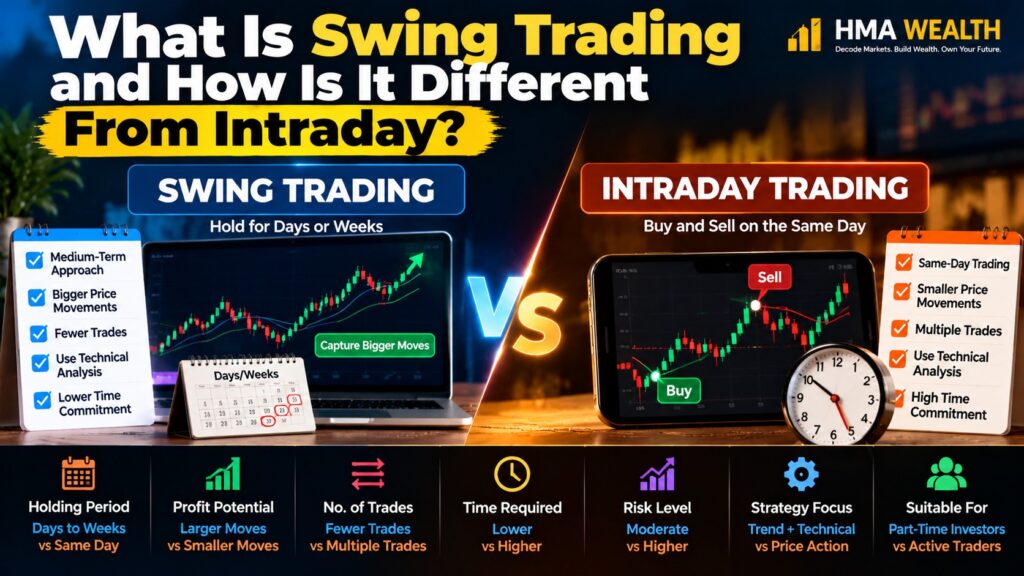
Table of Contents
A reader wrote to HMA Wealth describing his first month of intraday trading as “watching the screen for six hours and still losing money.” He’d read that trading was the fast way to grow capital, jumped straight into intraday without a full-time job that allowed it, and burned out within three weeks. What nobody had told him was that swing trading existed as a genuinely different, slower-paced option that didn’t require staring at charts all day.
That gap in basic awareness is common enough that it’s worth answering properly: what is swing trading, and why does confusing it with intraday send so many beginners down the wrong path before they’ve even started? If trading itself is entirely new territory for you, our broader guide on how to start investing is worth reading first, since this comparison assumes you already understand the basics of buying and selling through a demat account.
What Is Swing Trading in Simple Terms?
To answer what is swing trading directly: it means holding a stock for a period ranging from a few days to a few weeks, aiming to capture a meaningful “swing” in price rather than a full long-term trend. You’re not trying to predict where a company will be in five years; you’re trying to catch a shorter-term move up or down based on recent price action and momentum.
Unlike intraday trading, a swing trade doesn’t need to be closed the same day. You buy, hold the position overnight (sometimes for a week or two), and exit once your target is hit or the setup no longer looks valid.
Our broader breakdown of which type of trading is best for different people places swing trading squarely as a more manageable option for people who can’t watch the market constantly. Understanding what is swing trading properly before you start is also the single best way to avoid the exact confusion the reader from the intro ran into.
How Is Swing Trading Actually Different From Intraday Trading?
The core difference is time. Intraday trading, as the name suggests, requires opening and closing every position within the same trading day, with most brokers auto-squaring off any leftover position before the market closes. Swing trading holds positions overnight and across multiple days, sometimes weeks, deliberately.
This single difference cascades into everything else. Intraday traders need to watch screens actively during market hours, often reacting within minutes. Swing traders check in once or twice a day, set their levels, and let the trade play out without needing constant attention. Our explainer on how intraday trading actually works is a useful comparison read, since seeing the intraday discipline up close makes the swing trading alternative much easier to appreciate.
Does Swing Trading Require Less Capital Than Intraday?
Not necessarily less, but the capital requirement works differently. Intraday trading often uses margin, letting you control a larger position with a smaller amount of capital, since the position closes the same day. Swing trading typically requires full payment for the shares you buy, similar to a regular delivery purchase, since you’re holding the position overnight.
This means a swing trade can actually tie up more capital per position than an equivalent intraday trade, even though the overall approach feels less frantic. If you’ve ever used the “convert to delivery” option on your broker’s app, our guide on converting an intraday position to delivery explains exactly this mechanic, since it’s effectively turning an intraday trade into something closer to a swing or longer-term holding.
Our explainer on the 50/30/20 budgeting rule is worth reading too, since deciding how much capital to allocate toward any trading strategy should fit inside a broader monthly plan, not come out of money earmarked for essentials.
What Kind of Analysis Does Swing Trading Actually Rely On?
Swing traders lean heavily on technical analysis, chart patterns, moving averages, support and resistance levels, and momentum indicators, to time entries and exits. Fundamentals matter less here than they do for long-term investing, since the goal is capturing a price move over days or weeks, not years.
That said, swing traders generally still want to avoid stocks with genuinely weak fundamentals, since a short-term technical setup can fail badly if the underlying company has serious problems. Our guide on mutual funds for beginners is worth a look too, in case a professionally managed fund turns out to be a better fit than active swing trading for part of your capital. Our guide on the golden rule for stop-loss is essential reading here, since a swing trade without a predefined exit point is one of the fastest ways to turn a manageable loss into a painful one. This technical-analysis dependence is really at the heart of what is swing trading as a discipline, distinct from both pure chart-scalping and long-term fundamental investing.
Our broader explainer on common investing mistakes covers several that apply directly to swing trading too, like ignoring a company’s fundamentals entirely because a chart pattern looked convincing.
Why Do Beginners Often Confuse Swing Trading With Intraday?
Mostly because both get lumped together under the broad umbrella of “trading” as opposed to “investing,” and beginner content often doesn’t separate them clearly enough. Our explainer on the difference between trading and investing is worth reading first if even that broader distinction still feels blurry, since swing trading sits somewhere in between pure day trading and long-term investing.
The other reason is that both intraday and swing trading use similar technical tools, candlestick patterns, support and resistance, moving averages, which makes them look more similar on the surface than they actually are in practice. The real difference isn’t the tools; it’s the timeframe and the discipline each one demands.
Once you genuinely understand what is swing trading at a mechanical level, separating it from intraday stops being confusing, since the tools overlap but the entire rhythm of the two approaches doesn’t.
How Much Time Does Swing Trading Actually Require Each Day?
Considerably less than intraday trading. A swing trader typically reviews charts once in the morning before the market opens or once in the evening after it closes, places or adjusts orders accordingly, and doesn’t need to watch the screen continuously during trading hours.
This makes swing trading genuinely more compatible with a full-time job or other daytime commitments, which is exactly the gap the reader from the intro ran into. If you’re deciding between swing trading and other approaches based on how much time you realistically have, our broader guide on which type of trading is best for beginners is worth revisiting with this time-commitment angle specifically in mind.
HMA Wealth generally recommends being honest about your actual daily schedule before picking a trading style, rather than choosing based on which one sounds more exciting.
What Are the Actual Risks of Swing Trading That Beginners Underestimate?
Overnight and weekend risk is the big one. Since a swing position stays open outside market hours, news or events that happen while the market is closed, an earnings surprise, a global market move, a policy announcement, can cause the stock to open sharply higher or lower than where it closed, with no chance to react until the market reopens.
This is genuinely different from intraday trading, where your position is closed before any after-hours news can affect it. Swing traders need to size their positions and set their stop-losses with this overnight gap risk specifically in mind, not just the usual intraday volatility.
Our guide on the 1% rule is a useful companion here, for thinking about how much of your capital any single swing position should actually risk given this added overnight exposure.
Do You Need a Different Type of Account for Swing Trading?
No, the same demat and trading account used for any other equity trading works for swing trades too. The distinction is in how you place and manage the order, not in the account itself. Our guide on what a trading account actually is covers the basics if you haven’t set one up yet.
Where it does matter is choosing a broker with reasonable delivery brokerage and a platform that makes it easy to track multi-day positions with clear alerts, rather than one built purely around intraday speed. Our walkthrough on choosing a broker in India is worth a look with that specific lens. Understanding the role a broker actually plays also helps before you commit to one platform for either style of trading.
How Do You Actually Exit a Swing Trade Correctly?
Exiting is where a lot of swing traders lose discipline, either taking profits too early out of nervousness or holding too long hoping for more. The exit decision should ideally be set before you even enter the trade, a target price and a stop-loss, so the decision is made in advance rather than in the moment.
Our guide on how to square off a position covers the mechanics of actually closing a trade on your broker’s platform, whether you’re booking a profit or cutting a loss, which applies to swing positions just as much as intraday ones.
Our explainer on what the stock market actually is is worth revisiting too if the basics of what you’re actually buying and selling still feel unclear underneath all this strategy discussion.
What Mistakes Do Beginners Make When Starting With Swing Trading?
- Treating it like a slower version of intraday, without adjusting position size for the added overnight risk
- Skipping the stop-loss entirely, assuming a multi-day holding period gives the stock “time to recover” on its own
- Over-leveraging on margin meant for intraday, not realizing a swing position typically needs full delivery-style funding
- Ignoring fundamentals completely, buying purely on a chart pattern without checking whether the underlying company has any serious red flags
- Checking the position obsessively anyway, defeating the lower time-commitment benefit that’s supposed to be swing trading’s main advantage over intraday
Understanding what is swing trading before making any of these mistakes is far cheaper than learning them with real capital on the line.
If you’re still building your foundational understanding of how buying and selling actually works mechanically, our guide on when to buy stocks as a beginner is a useful starting point before layering swing-specific strategy on top. Our guide on common investing mistakes is worth a second look here too, since several of the same errors show up in swing trading under a slightly different disguise.
How Do You Decide If Swing Trading Is Actually Right for You?
- Be honest about your available time. If you can’t watch the market all day but can check in once or twice daily, swing trading fits better than intraday.
- Check your risk tolerance for overnight gaps, since a swing position can open sharply against you based on news you had no chance to react to.
- Make sure you have enough capital for full delivery-style funding, not margin-based intraday sizing. Our guide on understanding CAGR is worth reading too if you want to measure your actual swing trading returns properly over time, rather than eyeballing individual trade outcomes.
- Practice with a small position size first, rather than committing a large amount to your first few swing trades.
- Set your target and stop-loss before entering, not after you’re already emotionally invested in the trade’s outcome.
Our guide on how to start investing is worth a final read once you’ve decided whether swing trading fits your schedule, since it covers the broader groundwork worth having in place regardless of which trading style you eventually settle on.
At HMA Wealth, we generally encourage beginners to spend time understanding both intraday and swing trading mechanics on paper, or with genuinely small amounts, before scaling up either approach with real capital they can’t afford to lose. Our guide on building wealth over the long term is worth reading too, since trading strategies like this one are rarely meant to replace a broader long-term plan entirely.
This article is educational content meant to help you understand what swing trading is and how it differs from intraday trading, not personalised investment or trading advice. Trading, whether intraday or swing, carries real risk of capital loss, and past price patterns don’t assure future outcomes. Always do your own research and consult a SEBI-registered investment adviser before committing real capital to any trading strategy.
At the end of the day, what is swing trading comes down to one practical trade-off: slower-paced than intraday, but still far more hands-on than long-term investing, holding positions for days or weeks and accepting overnight risk in exchange for not needing to watch a screen all day. Knowing that distinction clearly, something the reader from the intro genuinely didn’t, is often the difference between a trading approach that fits your actual life and one that burns you out in three weeks.
FAQs — What Is Swing Trading
What is swing trading in the simplest terms?
Swing trading means holding a stock for a few days to a few weeks to capture a short-term price move, rather than closing the position the same day or holding for years. It sits between intraday trading and long-term investing.
What is swing trading’s main difference from intraday trading?
Timeframe. Intraday positions must close the same trading day, while swing positions are held overnight and across multiple days deliberately, accepting the extra risk of price gaps when markets are closed.
Does what is swing trading require more capital than intraday?
Often yes, per position. Swing trading typically needs full delivery-style funding, while intraday trading can use margin, so a swing trade can tie up more capital even though it feels less fast-paced.
Is swing trading riskier than intraday trading?
It carries a different risk, not necessarily a higher one. Swing trades face overnight and weekend gap risk from news or events while the market is closed, which intraday positions avoid entirely by closing before the session ends.
How much time does what is swing trading actually require each day?
Far less than intraday. Most swing traders check charts once or twice a day rather than watching the market continuously, which makes it more compatible with a full-time job.